
Hoses & connectors: $100–$200
The brittle old flexible behind the cooktop: tiny part, outsized share of the leaks we find.
There is no "close enough" in gas. Every job we do in Leichhardt, a leak chased down, a cooktop connected, a new line run to an outdoor kitchen: finishes the same way: holding pressure on a gauge, certified, documented. That is the whole standard, and it is not negotiable.
In NSW, every job on a gas installation: connecting a cooktop, moving a bayonet, repairing a line: must legally be done by a licensed gasfitter, and for good reason: the failure modes are leaks, fires and carbon monoxide, none of which give second chances. It is also why "the handyman hooked it up" appliances are the single most common source of the leaks we get called to.
Licensed does not just mean allowed. It means the job finishes with a manometer pressure test proving the whole installation holds, appliances checked for correct operation and ventilation, and work done to AS/NZS 5601, the standard that decides what your insurer thinks of the installation if anything ever goes wrong. Across Leichhardt and the Inner West, that is the finish line on every gas job we do.


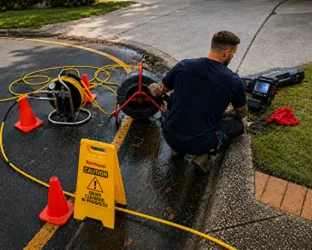
The Little Italy cafe and restaurant strip pushes fats and food waste into drains that build up and block without regular jetting.
Gas in a commercial kitchen is a different regime from a domestic one, interlocked ventilation, larger loads, appliance isolation requirements, and inspection obligations that fall on the operator rather than the plumber.
The practical consequence is that a commercial installation cannot be extended casually. Adding a wok burner changes the load, the ventilation calculation and the certification, and all three have to move together.
Gas runs in older homes are frequently black steel, and steel corrodes internally over decades. The bore narrows with scale, which starves appliances at the far end of the run, and the wall thins at the low points where moisture collects.
Every job finishes on a pressure test with a certificate. Gas has no visible half-finished state: an installation either holds and is certified, or it is not complete.
An appliance that has become unreliable at the end of a long old run is often reporting on the pipe rather than on itself. That is worth establishing before it gets replaced.
For a food business, gas is production. A cooktop out of service is not an inconvenience to schedule around, it is a menu that cannot be served.
Leichhardt sits at the heart of Sydney’s Inner West (postcode 2040), bordering Annandale, Lilyfield, Petersham, Lewisham and Haberfield. Home to the city’s Little Italy along Norton Street, its terraces and busy cafe strips give our drain crews steady work.
So we carry the common commercial failure parts and we work to your service times rather than ours. Where a part genuinely has to be ordered, you will hear that immediately along with what can be kept running in the meantime.
Older properties routinely have redundant gas pipework, a disconnected heater, a removed stove, a fireplace converted decades ago: and it is not always capped to any standard, or capped at all.
Those are found by pressure testing the whole installation rather than the part in use. It is the single most common reason an old house fails a test, and it is usually inexpensive to put right once located.
Commercial premises get inspected, insured and sold, and all three ask for the same thing: documentation that the gas installation is compliant and who certified it.
Every job we do finishes with a compliance certificate, and for commercial clients we keep the history so the paperwork exists when a landlord, insurer or inspector asks for it rather than being reconstructed under pressure.
A period home was not built with gas in mind. Whatever it has was added later, often several times, and the runs take whatever route was available at the time, under floors, through cavities, along the outside of a wall and back in.
Which is why the first job on an older property is usually establishing what is actually there. A pressure test tells you whether the installation is sound; it does not tell you where it goes, and both matter before anything is added.
The brittle old flexible behind the cooktop: tiny part, outsized share of the leaks we find.
Thread and valve leaks sealed properly and proven again on the gauge.
Corroded or damaged sections replaced; concealed lines with access work run $800–$2,500.
Connected, tested, certified. New line or bayonet to reach it quoted fixed on top.
Sydney's 2026 licensed-gasfitter range; attendance typically $80–$150. Certification is included, because without it there is no job.
Every gas job ends with a pressure test and the paperwork that proves it. Figures here are indicative of the 2026 Sydney market rather than a quote from us, you get your own number as a fixed price before any work starts.
A suspected leak starts with isolation at the meter and ventilation, before diagnosis, before anything. No reading is worth taking on an installation still feeding a leak.
A manometer pressure test tells us the installation is losing gas; gas detection equipment and controlled testing narrow it to the joint, fitting or run responsible.
The failed component or section is replaced, not doped up and hoped over, to AS/NZS 5601, whether that is one connector or a rerun line.
The whole installation holds pressure or the job is not finished. Appliances are relit and checked for correct burning, and you get the compliance side documented.
Cooktop, heater or barbecue point: connected, tested and certified in one visit. The right way costs less than the redo.
Licensed gasfitters, every job pressure-tested and certified. Smell gas right now? 131 909 first, then us.

Leave your details and our local Leichhardt team will call you back fast.